

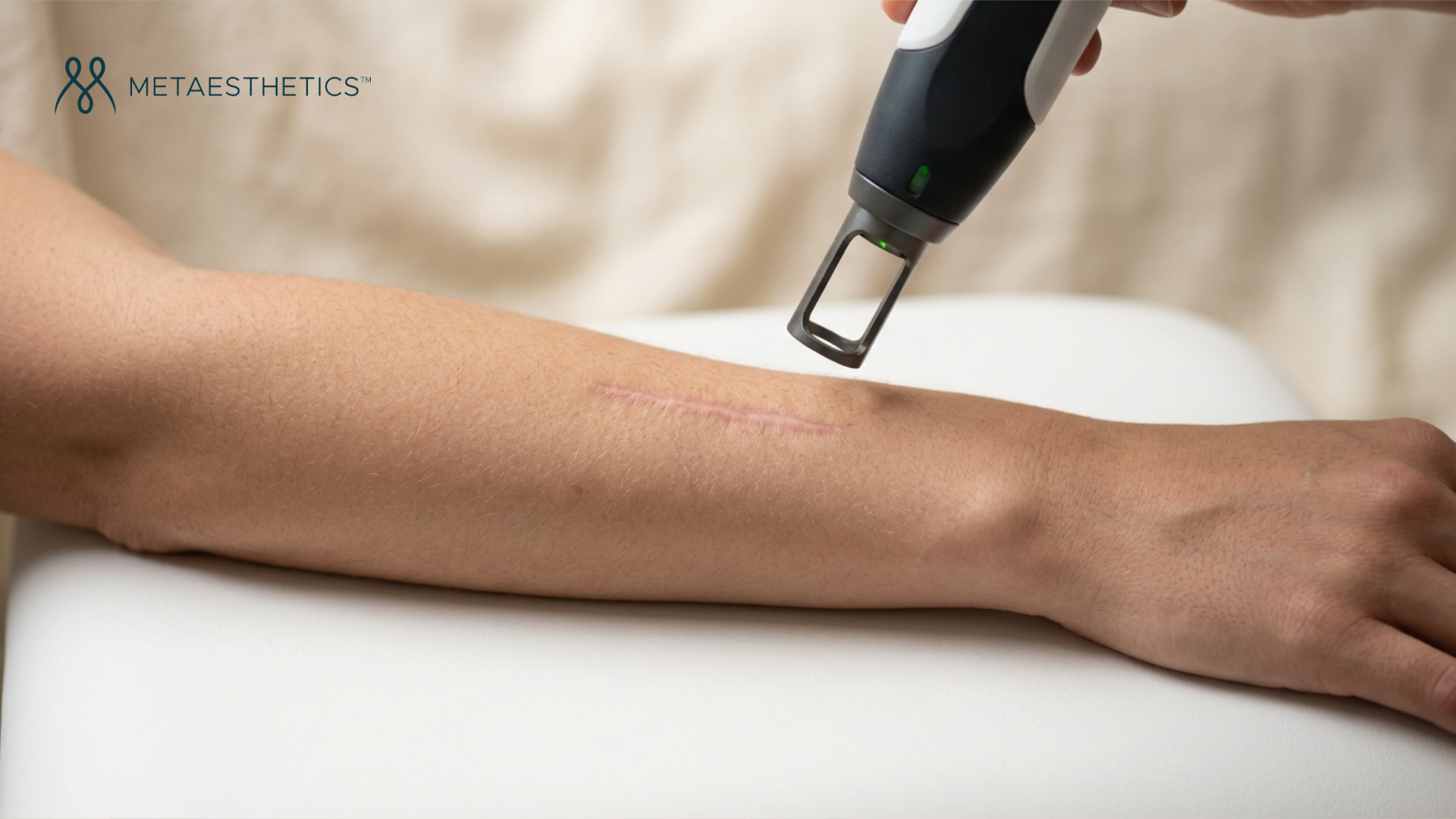
Scar treatment: a complete guide to understanding and taking action
Welcome to our page dedicated to scar treatment. Here you will find clear and balanced information to support your decision-making journey — without ever replacing a consultation with one of our partner doctors or surgeons, whose visibility reflects their recognised expertise. This article is informational and does not constitute medical advice: any treatment begins with an accurate diagnosis.
Key takeaways
- A scar does not disappear entirely: it can be significantly improved.
- Diagnosing the type of scar determines the entire treatment plan.
- The best results come from combined and progressive protocols.
- The practitioner's skill influences outcomes more than the technology alone.
- A treatment course may span several months, sometimes over a year.
Who is it for
Scar treatment is for anyone bothered by a scar, whether recent or long-standing. It can involve acne scars, surgical scars, traumatic scars, hypertrophic or keloid scars. Each profile requires a specific, often personalised approach.
In general, patients seek either an aesthetic improvement, functional relief (tightness, rigidity), or both. The psychological dimension is frequently significant, particularly when the scar is visible.
Limitations and contraindications
- Immature scar (usually less than 6 months old)
- Active skin infection
- Specific medications (depending on the case)
- History of keloids requiring specialised management
How it works
Scar treatment always begins with a thorough medical consultation. The practitioner analyses the type of scar, its age, the skin type and the patient's expectations. This step is crucial: a diagnostic error can lead to inappropriate treatment, or even worsening — particularly for keloid scars.
Depending on the case, a protocol may include several techniques: fractional laser, microneedling, subcision, injections or chemical peels. These treatments are generally spaced several weeks apart to respect the skin's biological rhythm.
The process is progressive. Results are not immediate: they often evolve over several months as collagen remodels.
Expected results
In general, treatments provide visible improvement in the texture, colour and contour of scars. The degree of improvement depends on the type of scar, its age and the chosen protocol.
Atrophic scars can often be significantly smoothed. Red scars may fade. Hypertrophic scars can soften and flatten. However, it is important to understand that no treatment restores skin to its original, pre-scar state.
Results are progressive and may become visible after several months. An improvement of 30 to 70% is commonly cited in the literature, depending on the case.
Risks and side effects
Scar treatments are generally well tolerated when performed in a rigorous medical setting. However, certain side effects can occur.
- Prolonged redness after laser or microneedling
- Bruising after subcision
- Post-inflammatory hyperpigmentation, especially on darker skin tones
- Rare infections
- Possible worsening of keloids if treatment is inappropriate
A keloid scar that is poorly managed can evolve unfavourably. This is why the initial diagnosis is essential.
Recovery and aftercare
Recovery varies depending on the technique used. Microneedling may cause redness lasting a few hours to a few days, while ablative fractional laser may require several days of social downtime.
The skin is often sensitive after treatment. Strict sun protection is essential. Compliance with post-treatment care directly influences the quality of the final result.
Alternatives
- No treatment (monitoring)
- Topical care (silicone, moisturising)
- Scar revision surgery in certain cases
- Combined medical and surgical approach
Questions to ask during consultation
- What exact type of scar do I have?
- What protocol do you recommend and why?
- How many sessions are typically needed?
- What results can I reasonably expect?
- What are the risks in my case?
- What follow-up do you offer after treatment?
Frequently asked questions
Can a scar be made to disappear?
No. A scar can often be improved, but it is rarely completely erased.
What is the best treatment?
There is no single best treatment. The choice depends on the type of scar.
How long does a treatment course take?
Often several months, sometimes over a year depending on the case.
Are the results long-lasting?
Generally yes, but maintenance may be needed depending on the situation.