
Laser hair removal: the complete guide to choosing wisely (2026)
Laser hair removal is today the most widely performed aesthetic treatment in the world. Yet between the promises of low-cost centres and clinical reality, between "definitive" and "permanent", between medical lasers and photoepilation in beauty salons, there is still considerable confusion. This guide was designed to address that: to understand before starting, compare before choosing, and decide with the right expectations.
1 Introduction: laser hair removal, freedom for life?
Every year, millions of people around the world choose laser hair removal to free themselves from the razor, wax and ingrown hairs. Born in the 1990s with the first ruby lasers, this treatment has undergone considerable technological evolution: today's latest-generation diode systems can treat all skin tones, from phototype I to phototype VI, with unmatched efficacy and safety.
But behind the enthusiasm lie persistent misunderstandings. Laser hair removal is not "definitive" in the absolute sense of the term: it permanently and significantly reduces hair growth, but does not eliminate it 100 % in all cases. It is a medical treatment — not a beauty ritual — that requires a diagnosis, adaptation to each patient's profile and rigorous follow-up. The difference between a good result and disappointment often comes down to the quality of the provider and the suitability of the equipment.
- Laser hair removal is the most widely performed aesthetic treatment in the world.
- The correct regulatory term is "permanent hair reduction", not "definitive hair removal".
- It is a medical procedure that requires a prior consultation and a personalised protocol.
- The quality of the equipment and the operator is decisive for safety and outcomes.
2 How does laser hair removal work?
The principle of laser hair removal is based on selective photothermolysis: the laser emits monochromatic light at a precise wavelength, preferentially absorbed by melanin — the pigment that colours the hair. This light energy is converted into heat, destroying the hair follicle without damaging the surrounding tissue. It is the selectivity of this reaction that makes the treatment both effective and safe, provided the parameters are correctly set.
The laser's efficacy depends directly on the hair cycle. Hair goes through three phases: anagen (active growth, when it is connected to the follicle and rich in melanin), catagen (regression) and telogen (rest). The laser acts only on hairs in the anagen phase — which is why several sessions, spaced a few weeks apart, are essential to reach all the follicles.
The difference between medical lasers and IPL (Intense Pulsed Light) is fundamental. A laser emits coherent light, at a single wavelength, concentrated and precise. IPL emits a broad light spectrum, less targeted and less powerful — with reduced efficacy and safety, particularly on darker skin. The two technologies are not equivalent, and this distinction is central to choosing a provider.
- The laser targets the melanin in the hair via selective photothermolysis.
- Only hairs in the anagen phase are treated — hence the need for several sessions.
- Medical lasers and IPL are two very different technologies in terms of efficacy and safety.
- Parameters (wavelength, fluence, pulse duration) must be tailored to each patient.
3 Laser technologies: which device for which profile?
Three main laser families dominate the medical hair removal market, each with a specific wavelength and precise indications.
The alexandrite laser (755 nm) is the fastest on large surfaces. Its short wavelength is very well absorbed by melanin, making it formidably effective on phototypes I to III — fair skin with dark hair. Its efficacy decreases on darker skin, and the risk of depigmentation increases beyond phototype III. It is the historic laser of specialised centres, particularly suited to the legs, underarms and arms.
The diode laser (810 nm) is today the market benchmark for its versatility. Its intermediate wavelength allows it to effectively treat phototypes I to V. The cooling systems integrated into the latest-generation devices — such as SHR mode (Super Hair Removal), which builds up heat progressively — have considerably improved treatment comfort. The diode laser is the most universal choice in 2026.
The Nd:YAG laser (1,064 nm) is the only one truly suitable for phototypes IV to VI. Its long wavelength penetrates more deeply into the dermis with reduced absorption by epidermal melanin, lowering the risk of burns and depigmentation on darker skin. It is slightly less effective than the alexandrite on very fair skin, but indispensable for medium to dark skin tones. It is also the preferred laser for sensitive areas in men.
Combined systems, which pair alexandrite and Nd:YAG in a single treatment head, optimise outcomes across all phototypes in a single session. These hybrid devices represent the state of the art in 2026.
Technology comparison table
| Technology | Wavelength | Compatible phototypes | Preferred areas | Efficacy | Comfort |
|---|---|---|---|---|---|
| Alexandrite | 755 nm | I to III | Legs, underarms, arms | Very high (fair skin) | Moderate |
| Diode | 808–810 nm | I to V | All areas | Very high (versatile) | Good to excellent |
| Nd:YAG | 1,064 nm | IV to VI | Dark skin, sensitive areas | High (dark skin) | Moderate |
| IPL | 500–1,200 nm | I to III only | Limited areas, fair skin | Moderate | Good |
- The diode laser is the 2026 benchmark for its versatility across phototypes I to V.
- The Nd:YAG laser is indispensable for medium to very dark skin (phototypes IV to VI).
- IPL is not a medical laser: its efficacy and safety are lower.
- Combined alexandrite + Nd:YAG systems offer the broadest treatment spectrum.
4 Treatable areas and their specific features
Almost every area of the body can be treated with laser hair removal, with a few exceptions. In women, the most frequently treated areas are the legs (full or half), the underarms — one of the most responsive zones, with excellent results —, the bikini area (standard, Brazilian or full), the arms, the upper lip and the chin. The female face requires great precision and fine parameter adjustment, particularly on hormonal zones such as the chin or cheeks, where partial regrowth is possible.
In men, demand has evolved considerably. The back and shoulders are the most treated area, with sessions lasting 45 to 90 minutes depending on hair density. The neck and the area around the face address the issue of chronic ingrown hairs caused by shaving — a medically relevant indication. The chest, abdomen, ears and pubic area are also treated using the same protocols as in women, adapted to male skin thickness and hair density.
Some areas call for particular vigilance. Periorbital zones (around the eyes) are strictly contraindicated without appropriate eye protection. Tattoos must never be exposed to a hair-removal laser: the risk of burns and tattoo alteration is real. Any area with atypical moles or pigmented lesions must undergo a prior dermatological assessment.
Table: areas × sessions × indicative pricing
| Treated area | Recommended number of sessions | Duration per session |
|---|---|---|
| Underarms | 6–8 | 10–15 min |
| Brazilian bikini | 6–8 | 20–30 min |
| Full bikini | 6–10 | 30–40 min |
| Half-legs | 6–8 | 30–45 min |
| Full legs | 6–8 | 60–90 min |
| Upper lip | 6–8 | 5–10 min |
| Back (men) | 6–10 | 45–90 min |
| Neck (men) | 6–8 | 15–25 min |
- Almost all body areas are treatable, with protocol adaptations depending on the zone.
- Male hair removal is growing rapidly: back, neck, ingrown facial hairs.
- Periorbital areas and tattoos are strict contraindications.
- Hormonal zones (chin, cheeks) may require touch-up sessions.
5 Phototypes and hair types: who is a candidate for laser hair removal?
The phototype — defined by the Fitzpatrick scale across six levels, from the fairest (I) to the darkest (VI) — is the most decisive parameter in choosing the laser and predicting outcomes. The fundamental rule is simple: laser hair removal works on the pigment contrast between dark hair and light skin. The higher this contrast, the greater the efficacy and the lower the risk of burns.
Phototypes I to III (fair to lightly tanned skin, brown to black hair) are the best candidates. The alexandrite and diode lasers deliver excellent results. Phototypes IV and V (medium to dark skin) can be treated effectively with the diode or Nd:YAG, provided the parameters are rigorously adjusted. Phototype VI (very dark skin) can only be treated with the Nd:YAG, by an experienced operator.
Very light blond, red, white or grey hair poses a real limit: its low melanin content makes the laser ineffective or barely effective. No current laser technology treats these hairs satisfactorily — information that should be honestly communicated before any consultation. Finally, hormonal hair growth — common in polycystic ovary syndrome (PCOS) — can partially recur even after a full course, due to continuous follicular stimulation. Associated medical follow-up is recommended in these cases.
- The Fitzpatrick scale (I to VI) is the starting point of any laser hair-removal protocol.
- The contrast between dark hair and fair skin is the key condition for efficacy.
- Blond, red, white or grey hairs do not respond to the laser — no exceptions.
- Hormonal hair growth (PCOS) may require regular touch-up sessions.
6 Choosing your provider: medical practice or aesthetic centre?
In Switzerland, the use of medical hair-removal lasers is governed by Swissmedic and subject to cantonal rules on medical practice. Only physicians or duly delegated healthcare professionals are authorised to use class IV lasers for aesthetic purposes. This regulation aims to guarantee patient safety in the face of the growing number of aesthetic centres offering devices of varying power, sometimes without sufficient medical oversight. Class IV medical lasers — those used for effective hair removal — are reserved for physicians or medical auxiliaries under direct medical responsibility. An aesthetic centre may legally use only IPL or low-power lasers, which are less effective. This regulatory distinction has direct consequences for safety and outcomes. In other European countries the legal framework varies: it is essential to verify the provider's qualifications before any session.
A reputable medical practice will systematically offer a prior medical consultation, including phototype assessment, a patch test on a small area and the definition of a personalised protocol. The type of device used will be clearly communicated, and the operator will be specifically trained in laser dermatology. Red flags to avoid: no consultation, no patch test, abnormally low prices, unqualified staff operating high-power lasers, and promises of guaranteed results in a fixed number of sessions.
The price of a session does not only reflect the area treated — it also reflects the quality of the equipment, the competence of the operator and the rigour of medical follow-up. A slashed price is rarely a good deal in the long term.
- In Switzerland, medical lasers are subject to Swissmedic regulations and cantonal rules — verify that the practitioner is authorised to perform medical aesthetic procedures.
- Class IV medical lasers are reserved for physicians or for those acting under their direct responsibility.
- A prior consultation and a patch test are non-negotiable standards.
- Check the type of device used: medical laser or simple IPL.
- Low-cost centres without medical consultation present real risks of burns and depigmentation.
7 The treatment process from A to Z
Preparation begins before the session: all waxing, tweezing or threading must be stopped four to six weeks beforehand — these methods remove the hair follicle, depriving the laser of its target. By contrast, shaving is recommended 24 to 48 hours before each session: it leaves the follicle in place while removing the visible hair. Any sun exposure must be avoided in the four weeks preceding the session, and self-tanning products are prohibited.
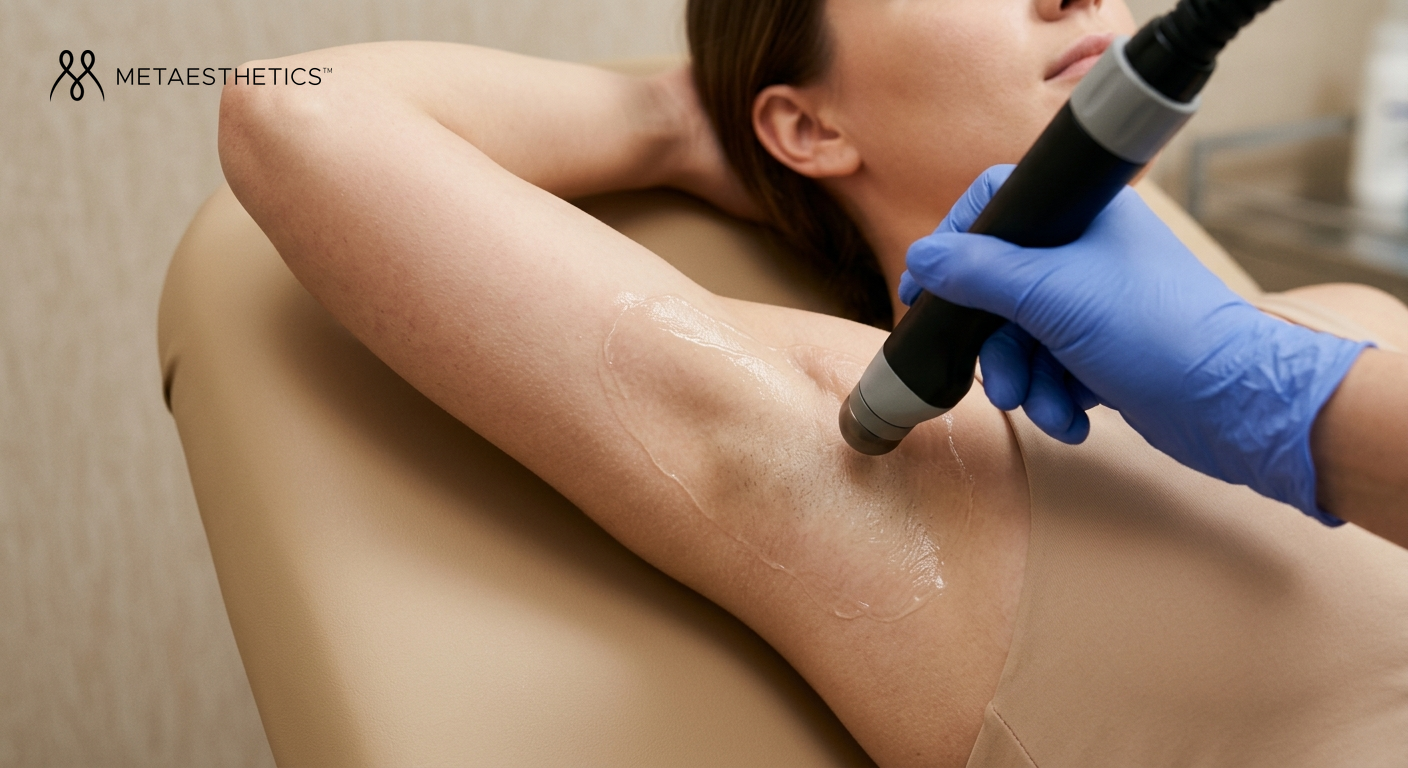
On the day of the session, the area is cleansed, contact gel is applied for certain devices, and the operator sets the laser parameters according to the phototype and zone. Sensation varies: it is often described as intense brief heat, comparable to the snap of an elastic band, with intensity varying by area (the groin and upper lip being more sensitive than the legs). Sessions last from ten minutes for the underarms to over an hour for full legs.
Within 48 hours of the session, slight redness and follicular oedema are normal and transient. Sun exposure, hot baths, intense sport and any irritating products must be avoided. The spacing between sessions — generally four to eight weeks depending on the area and hair cycle — is essential to synchronise treatment with the anagen phase.
- Stop waxing and tweezing 4 to 6 weeks before; shave 24 to 48 hours before the session.
- Avoid any sun exposure in the 4 weeks before and after each session.
- Post-session redness and follicular oedema are normal and transient.
- Respecting the intervals between sessions is as important as the sessions themselves.
8 Results, durability and realistic expectations
After a full course of six to ten sessions, depending on the area and profile, hair reduction is generally between 70 and 90 %. This result is lasting — most destroyed follicles do not regenerate. However, annual or biannual touch-up sessions are often necessary to treat the few residual follicles or those reactivated by hormonal changes.
Individual variability is real: phototype, hair type, follicular density, hormonal balance and treated area all influence the final result. A woman with PCOS will obtain good initial results, but partial regrowth is predictable without associated hormonal treatment. A man with a very dense back will likely need to plan for more sessions than a man with moderate hair growth.
- A 70 to 90 % reduction in hair growth is the average result after a full course.
- Periodic touch-up sessions often remain necessary.
- Hormonal changes (pregnancy, menopause, PCOS) can reactivate certain follicles.
- Blond, white or grey hairs do not respond to the laser, regardless of results in other areas.
9 Risks, side effects and contraindications
In a rigorous medical setting, laser hair removal has an excellent safety profile. Common side effects — redness, warmth, mild sensitivity — are transient and disappear within a few hours. Rare but serious side effects include burns (caused by excessive fluence, misassessed phototype or recent sun exposure), hypopigmentation (lighter patches) or hyperpigmentation (darker patches), and in rare cases scars. These complications arise almost exclusively outside an appropriate medical setting or when contraindications are disregarded.
Absolute contraindications are: pregnancy, recent sun exposure or active tanning, the use of photosensitising medications (certain antibiotics, isotretinoin, antimalarials), and certain active skin conditions in the area to be treated. Relative contraindications include photosensitive epilepsy, the presence of a pacemaker in the immediate vicinity of the treated area, and recent scars. Laser hair removal must never be performed over a tattoo.
- Within a medical setting, laser hair removal is generally a safe treatment.
- Burns and depigmentation occur almost exclusively outside a medical setting or in the presence of contraindications.
- Pregnancy, recent tanning and photosensitising drugs are absolute contraindications.
- Never treat a tattoo with a hair-removal laser.
10 Financial aspects
Laser hair removal is not reimbursed by health insurance in the vast majority of cases. The rare exceptions concern documented pathological hirsutism (notably linked to PCOS) and, in some countries, facial hair removal as part of a medically supervised gender transition pathway. In all other cases, it is an investment fully borne by the patient.
Spread over ten years, the economic calculation is often favourable. The quality-durability ratio clearly argues in favour of the laser in the medium term.
- Be wary of unusually cheap packages: they often conceal lower-performance equipment or insufficient follow-up.
11 Special cases and frequently asked questions
Pregnancy is a formal contraindication to laser hair removal, as a precautionary measure. No study has demonstrated a direct foetal risk, but the lack of sufficient data justifies systematically halting treatment as soon as pregnancy is confirmed. Treatment can resume after childbirth and the end of breastfeeding, with a new phototype assessment if the pregnancy has altered skin pigmentation.
Transgender individuals are increasingly turning to laser hair removal, notably for facial hair removal as part of gender transition. Dense hormonal hair and extensive areas to be treated require adapted and supportive care, often with longer protocols. In some countries, this treatment is partially covered within a medically supervised transition pathway.
Hirsutism linked to PCOS is a recognised medical indication. Laser hair removal effectively treats the visible symptom, but without associated hormonal treatment, partial regrowth is frequent. Coordination with an endocrinologist is recommended to treat the underlying cause in parallel. Finally, the sun remains the treatment's main enemy: no session should be performed on tanned skin or skin exposed in the previous four weeks, and SPF 50+ sun protection is mandatory between sessions on treated areas.
- Pregnancy: formal contraindication; treatment can resume after childbirth and breastfeeding.
- Male hair removal and gender transition: rapidly growing indications with tailored protocols.
- Hirsutism/PCOS: treat the underlying hormonal cause in parallel for lasting results.
- Sun and self-tanners: incompatible with laser hair removal — SPF 50+ is mandatory between sessions.
12 Conclusion: laser hair removal, a lasting choice
In 2026, laser hair removal remains one of the best long-term aesthetic investments for people with the right profile — sufficient contrast between hair colour and skin tone, and no medical contraindication. Current technologies can effectively and safely treat a very wide range of phototypes, from the fairest to the darkest, with lasting results and considerably improved session comfort.
But laser hair removal remains, above all, a medical procedure. Its success depends on the quality of the initial diagnosis, the suitability of the laser to the patient's profile and the rigour of follow-up. Choosing your provider carefully — verifying qualifications, the equipment used and the presence of a prior medical consultation — is the most important decision you can make before starting. The freedom that lasting hair reduction provides is worth this investment of time and discernment.
- Laser hair removal is effective, safe and lasting — provided the right laser, the right profile and the right provider.
- It is a medical procedure: a prior consultation is indispensable, not optional.
- The 2026 technologies can treat almost all phototypes with an excellent safety profile.
- Only a qualified physician can assess your phototype and define the protocol suited to your objectives.